
MYWAY Metal Washers – Wide Range, Great Value. Your China Fastener Manufacturer.
11+ Years Expertise | Professional Fastener Manufacturer | Standard & Custom Parts | DIN, ISO, ANSI Certified | Strong R&D | Ample Stock | Cost-Effective |
Professional Team | Serving 40+ Countries | Reliable Logistics
Washers
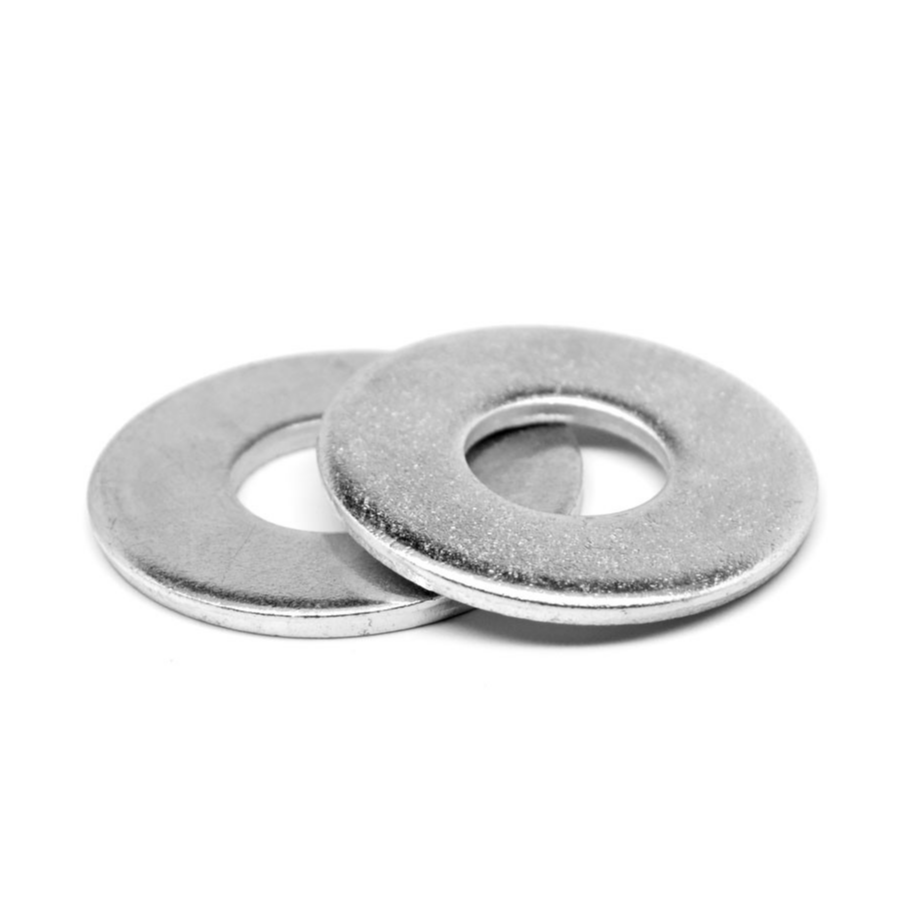
Flat Washers
DIN125 | DIN 7092 | DIN 9021 | DIN 6902/6903 …
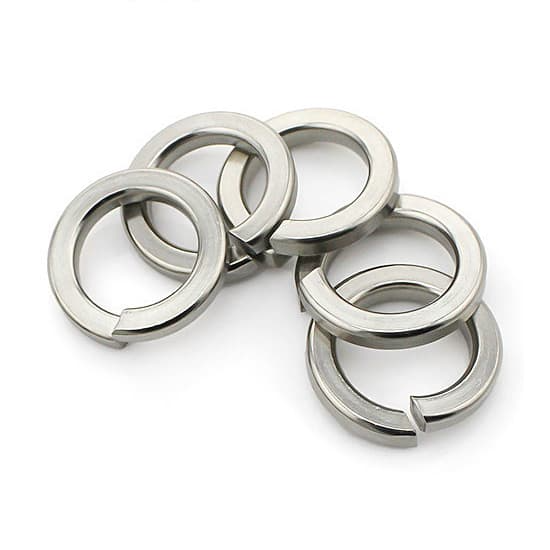
Spring Washers
DIN127 | DIN 128 | DIN 6796 | DIN 9250 …
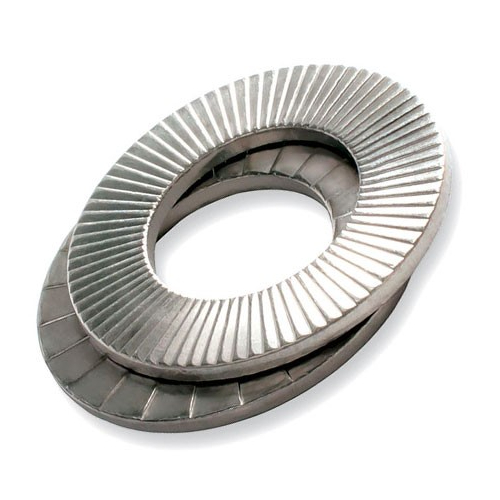
Lock Washers
DIN 6798 | DIN 6797 | DIN 137 | DIN 25201 …
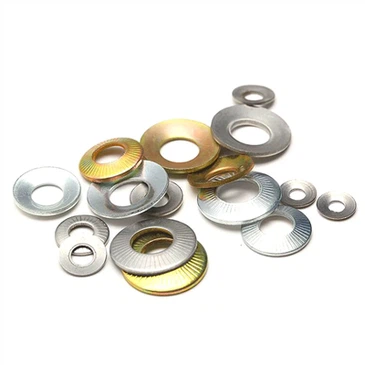
Other Washers
DIN 436 | DIN 434
What Is a Washer?
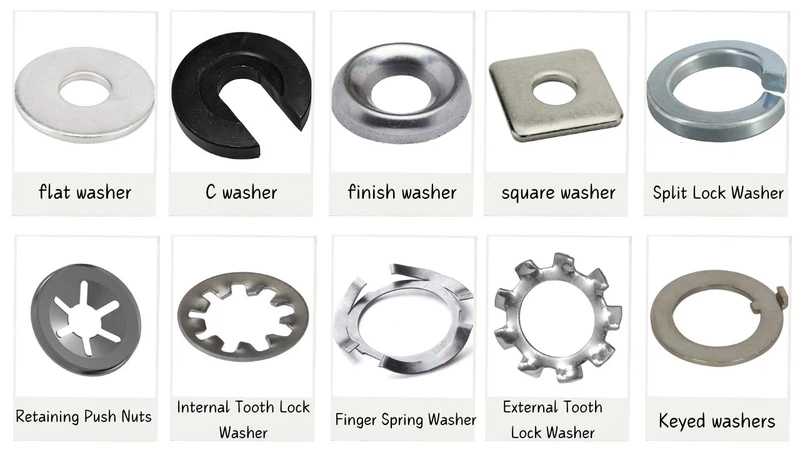
A washer is a thin plate (typically disk-shaped, but sometimes square) with a hole (typically in the middle) that is normally used to distribute the load of a threaded fastener, such as a bolt or nut. Other uses are as a spacer, spring (Belleville washer, wave washer), wear pad, preload indicating device, locking device, and to reduce vibration (rubber washer).
Washers are usually metal or plastic. High-quality bolted joints require hardened steel washers to prevent the loss of pre-load due to brinelling after the torque is applied. Washers are also important for preventing galvanic corrosion, particularly by insulating steel screws from aluminium surfaces. They may also be used in rotating applications, as a bearing. A thrust washer is used when a rolling element bearing is not needed either from a cost-performance perspective or due to space restraints. Coatings can be used to reduce wear and friction, either by hardening the surface or by providing a solid lubricant (i.e. a self-lubricating surface).
Types of Washers:
Washers are available for an infinite number of uses. Whenever two surfaces need to be connected securely, washers play an essential role. Many types of washers are commonly used.
These are made from various metals and materials specifically designed for special applications.
Specialised washers are available in three basic types: flat,spring,and lock.
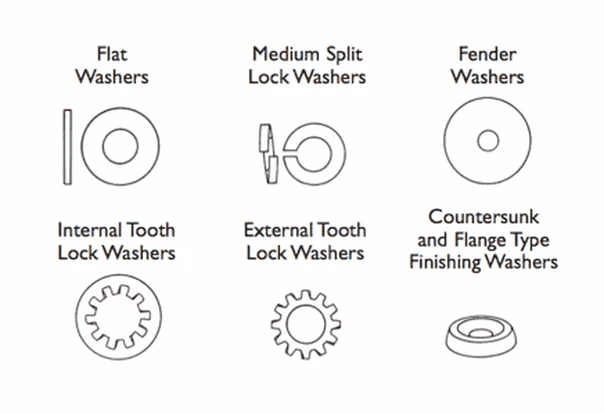
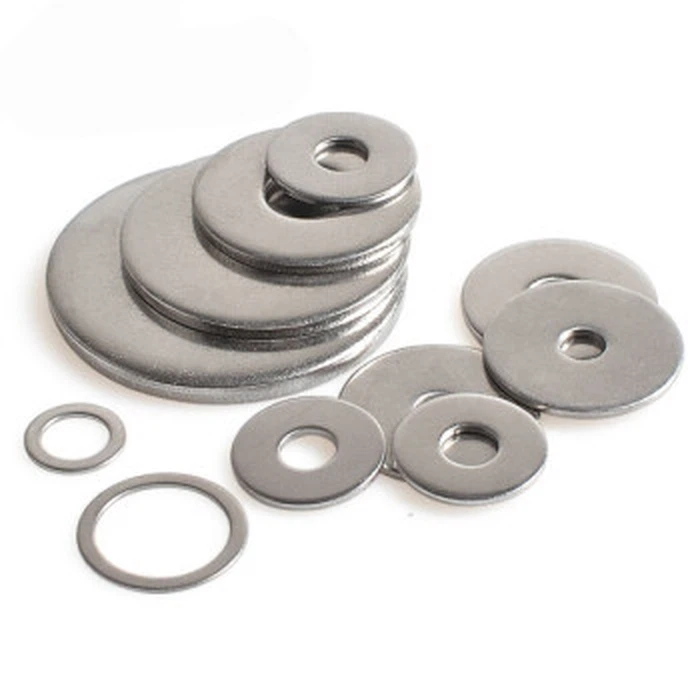
1.Flat Washers /Plain Washers
A hole in the centre of a plain washer has a metal ring surrounding it. As with other washers, flat washers have variations to meet the needs of applications, though they are familiar and have been used for many years.
Types of Plain Washers
Torque – Torque washers have square holes surrounded by pointy forks. During torque washer tightening, the torque washer’s forks bite the material’s surface to prevent the bolt or nut from spinning.
Flat – Flat washers have a hole in the middle and are thin and round. The screws are designed to support small heads. Flat washers are used when there is a need to spread the load.
Fender – Fender washers have the same shape as flat washers. Their hole size and circumference differ from flat washers. A fender washer’s outside diameter is disproportionately larger than its hole diameter. There is a large area of metal surface to support the load.
Countersunk – These are designed for flat-head screws. Screws and washers form flat surfaces when tightened.
Shoulder – Shoulder washers have a shoulder around their hole. They protect a wire, screw, or assembly.
C-Washer – C-washers are plain flat washers with a large section of the metal diameter removed to form the letter C. Slots on C-washers are cut from the edges of the central hole to the edge of the washer. It is not necessary to move or loosen the fastener to position or place it.
2. Spring Washer
Metal spring washers have slightly raised ends that create tension in the metal. Over or below a bolt or nut, they are placed.
Levelling the raised and lowered ends of nuts or bolts prevents them from loosening when tightened.
Spring Washers Types
Conical – Conical washers can hold tension during thermal expansion and contraction while supporting heavy forces. Height and thickness determine the deflection rate of a conical washer.
Dome – Dome washers have rounded sides instead of conical ones. With slight deflection, they can carry high loads.
Wave – Wave spring washers have a unique structure that allows them to rotate in two directions. Cushion springs and spacers are ideal applications for them.
Finger – Finger washers have three curved flanges that reduce damping, noise, wear, vibration, and skidding. Wave washers have similar load points.
Crescent – Crescent washers resemble flat washers with a bend in the middle. With the washer’s curve, minimal pressure is applied while maintaining flexibility.
Flexible and load-cycling products use these springs because they have uniform rates throughout the deflection range.
3. Lock Washer
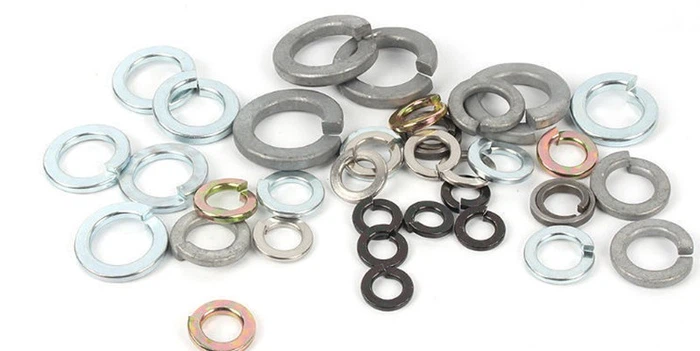
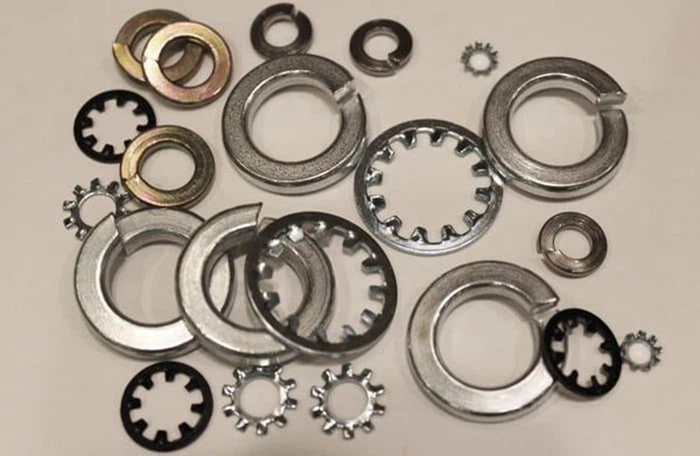
A lock washer is a device that locks nuts and bolts in place, which is its purpose. Lock washers come in various forms, but split and teeth washers are the most common.
Locking in the split or teeth prevents the bolt or nut from loosening.
Types of Lock Washers
Split – Split lock washers consist of a metal ring and a hole in the centre, similar to flat washers. An example of a split washer is a ring with a slit that makes the metal take on the shape of a spring with one section above the other.
A divided washer resembles a spring, so it is called a spiral washer.
External Teeth – An external teeth lock washer comprises evenly spaced teeth around its circumference. During tightening, bolt or nut teeth dig into the material’s surface.
Internal Teeth – Internal teeth washers have teeth but are located inside the ring’s diameter, unlike external teeth washers. These internal teeth serve to absorb shocks and vibrations and effectively secure the lock washer in place.
Craftsmanship And Process Of Washers
Here are the steps for the manufacturing process of washers.
1. Metal Stamping
The stamping process carried out on a power press, produces washers. During stamping or power pressing, a die determines the washer form. Metal stamping involves punching a shape or form out of flat metal with a die. A ram comes down with significant force on the bolster plate, punching out shapes from flat sheets of metal, known as blanks. There are two types of stamping machines: mechanical with flywheels and hydraulic.
2. Washer Dies
A washer die is a customised form used to manufacture washers. A single metal sheet is used for multiple washers since washers are small items. Using stamping technology, large amounts of washers can be produced while maximising the use of metal sheets.
3. Gauge of Metals
A washer's thickness is determined by its gauge, which also determines its spacing. As early as the industrial revolution, there wasn't a single method for determining viscosity, so gauges were used to measure it. Each metal type has its own gauge chart because gauges are not uniform.
Washer Dimensions:
Washers are measured and characterized by either imperial or metric design units. The dimension of washers can be specified by standard nominal values, gaged values, or may be customized for particular applications. Nominal ANSI sizes refer to the size of the fastener that the washer is designed to mate with. Nominal SAE, USS, and JIS sizes not only specify the inner diameter of the washer but also dictate the outer diameter and thickness of the washer.
1、S.A.E. DIMENSIONS FOR HARDENED FLAT WASHERS
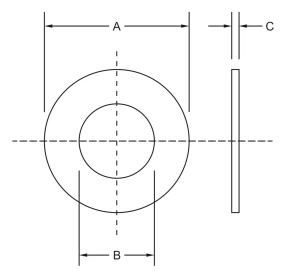
Bolts Size | A O.D. | B I.D. | C Thickness | |
Min | Max | |||
1/4″ | 5/8 | 9/32 | 0.051 | 0.08 |
5/16″ | 11/16 | 11/32 | 0.051 | 0.08 |
3/8″ | 13/16 | 13/32 | 0.051 | 0.08 |
7/16″ | 59/64 | 15/32 | 0.051 | 0.08 |
1/2″ | 1-1/16 | 17.32 | 0.097 | 0.177 |
5/8″ | 1-5/16 | 11/16 | 0.122 | 0.177 |
3/4″ | 1-15/32 | 13/16 | 0.122 | 0.177 |
7/8″ | 1-3/4 | 15/16 | 0.136 | 0.177 |
1″ | 2 | 1-1/8 | 0.136 | 0.177 |
1-1/8″ | 2-1/4 | 1-1/4 | 0.136 | 0.177 |
1-1/4″ | 2-1/2 | 1-3/8 | 0.136 | 0.177 |
1-3/8″ | 2-3/4 | 1-1/2 | 0.136 | 0.177 |
1-1/2″ | 3 | 1-5/8 | 0.136 | 0.177 |
1-3/4″ | 3-3/8 | 1-7/8 | 0.178 | 0.28 |
2″ | 3-3/4 | 2-1/8 | 0.178 | 0.28 |
2-1/4″ | 4 | 2-3/8 | 0.24 | 0.34 |
2-1/2″ | 4-1/2 | 2-5/8 | 0.24 | 0.34 |
2-3/4″ | 5 | 2-7/8 | 0.24 | 0.34 |
3″ | 5-1/2 | 3-1/8 | 0.24 | 0.34 |
3-1/4″ | 6 | 3-3/8 | 0.24 | 0.34 |
3-1/2″ | 6-1/2 | 3-5/8 | 0.24 | 0.34 |
3-3/4″ | 7 | 3-7/8 | 0.24 | 0.34 |
4″ | 7-1/2 | 4-1/8 | 0.24 | 0.34 |
2、USS DIMENSIONS FOR HARDENED FLAT WASHERS
Bolts Size | A O.D. | B I.D. | C Thickness | |
Min | Max | |||
5/16″ | 7/8 | 3/8 | 0.064 | 0.104 |
3/8″ | 1 | 7/16 | 0.064 | 0.104 |
7/16″ | 1-1/4 | 1/2 | 0.064 | 0.104 |
1/2″ | 1-3/8 | 9/16 | 0.086 | 0.132 |
9/16″ | 1-1/2 | 5/8 | 0.086 | 0.132 |
5/8″ | 1-3/4 | 11/16 | 0.108 | 0.16 |
3/4″ | 2 | 13/16 | 0.122 | 0.177 |
7/8″ | 2-1/4 | 15/16 | 0.136 | 0.192 |
1″ | 2-1/2 | 1-1/16 | 0.136 | 0.192 |
1-1/8″ | 2-3/4 | 1-1/4 | 0.136 | 0.192 |
1-1/4″ | 3 | 1-3/8 | 0.136 | 0.192 |
1-3/8″ | 3-1/4 | 1-1/2 | 0.153 | 0.213 |
1-1/2″ | 3-1/2 | 1-5/8 | 0.153 | 0.213 |
3、S.A.E. DIMENSIONS FOR LOW CARBON FLAT WASHERS
Bolts Size | A O.D. | B I.D. | C Thickness |
1/8″ | 3/8 | 5/32 | 3/64 |
5/32″ | 7/16 | 3/16 | 3/64 |
3/16″ | 1/2 | 7/32 | 3/64 |
7/32″ | 9/16 | 1/4 | 3/64 |
1/4″ | 5/8 | 9/32 | 1/16 |
5/16″ | 11/16 | 11/32 | 1/16 |
3/8″ | 13/16 | 13/32 | 1/16 |
7/16″ | 59/64 | 15/32 | 1/16 |
1/2″ | 1-1/16 | 17/32 | 3/32 |
9/16″ | 1-3/16 | 19/32 | 3/32 |
5/8″ | 1-5/16 | 21/32 | 3/32 |
3/4″ | 1-1/2 | 13/16 | 9/64 |
7/8″ | 1-3/4 | 15/16 | 9/64 |
1″ | 2 | 1-1/16 | 9/64 |
1-1/8″ | 2-1/4 | 1-1/4 | 9/64 |
1-1/4″ | 2-1/2 | 1-3/8 | 5/32 |
1-3/8″ | 2-3/4 | 1-1/2 | 5/32 |
1-1/2″ | 3 | 1-5/8 | 5/32 |
4、USS DIMENSIONS FOR LOW CARBON FLAT WASHERS
Bolts Size | A O.D. | B I.D. | C Thickness |
3/16″ | 9/16 | 1/4 | 3/64 |
1/4″ | 3/4 | 5/16 | 1/16 |
5/16″ | 7/8 | 3/8 | 5/64 |
3/8″ | 1 | 7/16 | 5/64 |
7/16″ | 1-1/4 | 1/2 | 5/64 |
1/2″ | 1-3/8 | 9/16 | 7/64 |
9/16″ | 1-1/2 | 5/8 | 7/64 |
5/8″ | 1-3/4 | 11/16 | 9/64 |
3/4″ | 2 | 13/16 | 5/32 |
7/8″ | 2-1/4 | 15/16 | 11/64 |
1″ | 2-1/2 | 1-1/16 | 11/64 |
1-1/8″ | 2-3/4 | 1-1/4 | 11/64 |
1-1/4″ | 3 | 1-3/8 | 11/64 |
1-3/8″ | 3-1/4 | 1-1/2 | 3/16 |
1-1/2″ | 3-1/2 | 1-5/8 | 3/16 |
1-5/8″ | 3-3/4 | 1-3/4 | 3/16 |
1-3/4″ | 4 | 1-7/8 | 3/16 |
1-7/8″ | 4-1/4 | 2 | 3/16 |
2″ | 4-1/2 | 2-1/8 | 3/16 |
2-1/4″ | 4-3/4 | 2-3/8 | 7/32 |
2-1/2″ | 5 | 2-5/8 | 15/64 |
2-3/4″ | 5-1/4 | 2-7/8 | 1/4 |
3″ | 5-1/2 | 3-1/8 | 17/64 |
5、SPRING STEEL & HARDENED STEEL SPLIT LOCK WASHER DIMENSIONS
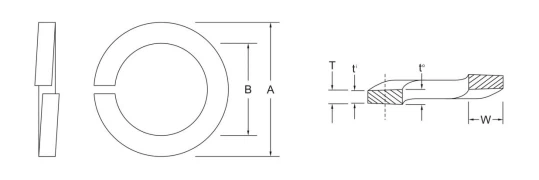
Bots Size | A O.D. | B I.D. | T Mean Section Thickness (ti + to)/2 | W Section Width | ti – to Increase in Thickness (O.D. to I.D.) | ||
Min | Max | Min | Max | ||||
#6 | 0.250 | 0.148 | 0.141 | 0.31 | 0.047 | 0.003 | 0.0015 |
#8 | 0.293 | 0.174 | 0.167 | 0.04 | 0.055 | 0.0036 | 0.0018 |
#10 | 0.334 | 0.200 | 0.193 | 0.047 | 0.062 | 0.004 | 0.002 |
1/4″ | 0.487 | 0.260 | 0.252 | 0.062 | 0.109 | 0.007 | 0.0035 |
5/16″ | 0.583 | 0.322 | 0.314 | 0.078 | 0.125 | 0.008 | 0.004 |
3/8″ | 0.680 | 0.385 | 0.377 | 0.094 | 0.141 | 0.009 | 0.0045 |
7/16″ | 0.776 | 0.450 | 0.44 | 0.109 | 0.156 | 0.01 | 0.005 |
1/2″ | 0.869 | 0.512 | 0.502 | 0.125 | 0.171 | 0.011 | 0.0055 |
9/16″ | 0.965 | 0.574 | 0.564 | 0.141 | 0.188 | 0.012 | 0.006 |
5/8″ | 1.072 | 0.640 | 0.628 | 0.156 | 0.203 | 0.013 | 0.0065 |
3/4″ | 1.264 | 0.765 | 0.753 | 0.188 | 0.234 | 0.015 | 0.0075 |
7/8″ | 1.455 | 0.890 | 0.878 | 0.219 | 0.266 | 0.017 | 0.0085 |
1″ | 1.647 | 1.015 | 1.003 | 0.25 | 0.297 | 0.019 | 0.0095 |
1-1/8″ | 1.838 | 1.144 | 1.129 | 0.281 | 0.328 | 0.021 | 0.0105 |
1-1/4″ | 2.028 | 1.272 | 1.254 | 0.312 | 0.359 | 0.023 | 0.0115 |
1-3/8″ | 2.21 | 1.399 | 1.379 | 0.344 | 0.391 | 0.025 | 0.0125 |
1-1/2″ | 2.409 | 1.524 | 1.504 | 0.375 | 0.422 | 0.027 | 0.0135 |
6、HARDENED BEVELED WASHER DIMENSIONS
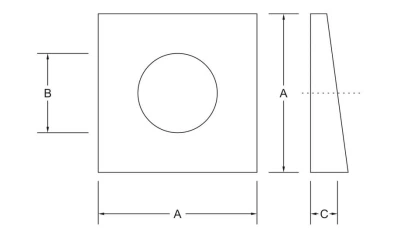
Bolts Size | A MIN. | B I.D. | C Mean Thickness | Slope or Taper in Thickness |
1/2″ | 1.750 | 0.531 | 5.16 | 1:06 |
5/8″ | 1.75 | 0.688 | 5.16 | 1:06 |
3/4″ | 1.750 | 0.812 | 5.16 | 1:06 |
7/8″ | 1.750 | 0.937 | 5.16 | 1:06 |
1″ | 1.750 | 1.125 | 5.16 | 1:06 |
Material Of Washers
Washers can be fabricated from a variety of materials including, but not limited to:
●Steel – Carbon steel, spring steel, A2 (304) stainless steel, and A4 (316/316L) stainless steel
●Non-ferrous metal – Copper, brass, aluminium, titanium, iron, bronze, and zinc
●Alloy – Silicon bronze, Inconel, Monel, and Hastelloy
●Plastic – Thermoplastics and thermosetting polymers such as polyethylene, PTFE (Teflon)
●Nylon – Nylon 6, Nylon 66, Nylatron, and Tecamid MDS
●Specialty – Fibers, ceramics, rubber, felt, leather, bimetals, and mica
●Phenolic – The material has good electrical insulation, is lightweight, tough, has low moisture absorption, is heat resistant, and is resistant to chemicals and corrosion. Phenolic washers are substitutes for flat metallic washers in cases where electrical insulation is required. Phenolic washers are stamped out of large sheets of the phenolic material. The term “phenolic washer” is sometimes used for stamped washers from laminated materials such as paper, canvas, and Mylar.
Corrosion resistance
A number of techniques are used to enhance the corrosion resistant properties of certain washer materials:
●Metallic coatings – Typical coatings used to produce corrosion resistant washers are zinc, cadmium, and nickel. Zinc coating acts as a sacrificial surface layer that falls victim to corrosive materials before the washer’s material can be harmed. Cadmium produces a high-quality protective surface but is toxic, both biologically and environmentally. Nickel coatings add protection from corrosion only when the finish is dense and non-porous.
●Electroplating – This method involves coating the washer by electrolytic deposition using metals such as chromium or silver.
●Phosphating – A resilient, but abrasive surface is achieved by incorporating a zinc-phosphate layer and corrosion-protective oil.
●Browning or bluing – Exposing the washer (typically steel) to a chemical compound or alkali salt solution causes an oxidizing chemical reaction, which results in the creation of a corrosion-resistant, colored surface. The integrity of the coating can be improved by treating the finished product with a water-displacing oil.
●Chemical plating – This technique utilizes a nickel-phosphor alloy that is precipitated onto the washer surface, creating an extremely corrosion- and abrasive-resistant surface.
Washers Standards And Form You Need To Know
Specifications for standard metric flat washers were known as DIN 125 (withdrawn) and replaced with ISO 7089. DIN (Deutsches Institut für Normung – German Institute for Standardization) standards are issued for a variety of components including industrial fasteners as Metric DIN 125 Flat Washers. The DIN standards remain common in Germany, Europe and globally even though the transition to ISO standards is taking place. DIN standards continue to be used for parts which do not have ISO equivalents or for which there is no need for standardization.
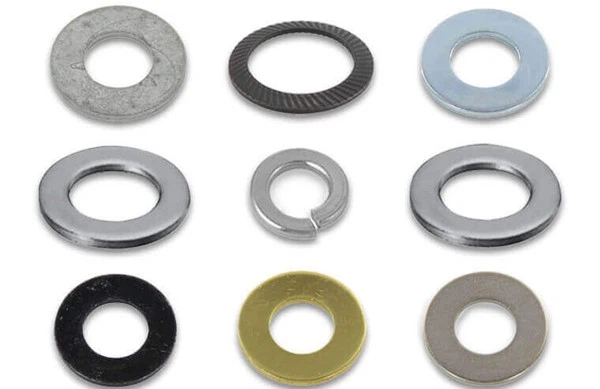
ASME ANSI B18.22.1 Plain Washers
The ASTM F844 standard covers the widely used inch series flat washers. These flat washers are made with a bearing surface and utilized under bolt heads or bolt-like external threaded fasteners.
ASME B18.21.1 Helical Spring-Lock Washer
Spring lock washers from the inch series are available in ordinary, heavy, extra-duty, and high-collar varieties. It is constructed from stainless steel, 65Mn or #70 steel, or spring steel. For common applications, spring lock washers distribute the load over a larger area for some head designs and offer a hardened bearing surface to make up for acquired looseness between assembly component components.
DIN 125A Flat Washers
Flat washers under DIN 125A specifications are made of sheet metal, have a smooth bearing surface, and go underneath the heads of nuts and bolts. Flat washers are often constructed of stainless steel and carbon steel.
DIN 6799 Retaining Washers
A type of spring steel or other high-performance washers, stainless steel produced machinery component is the DIN6799 retention washer, often known as an E-Ring. It is used as an eccentric shaft with grooves for spring retention and is appropriate for transmitting axial forces.
Standards We Can Provide:DIN,BS,ANSI/ASME/ASTM/,ISO,EN,GOST etc.
The American National Standards Institute (ANSI) provides standards for general use flat washers. Type A is a series of steel washers at broad tolerances, where precision is not critical. Type B is a series of flat washers with tighter tolerances where outside diameters are categorized as “narrow”, “regular” or “wide” for specific bolt sizes.
“Type” is not to be confused with “form” (but often is). The British Standard for Metric Series Metal Washers (BS4320), written in 1968, coined the term “form”. The forms go from A to G and dictate the outside diameter and thickness of the flat washers.
Form A: Normal diameter, normal thickness
Form B: Normal diameter, light thickness
Form C: Large diameter, normal thickness
Form D: Large diameter, light thickness
Form E: Normal diameter, normal thickness
Form F: Large diameter, normal thickness
Form G: Largest diameter, larger thickness.
Washer ‘form’ when comparing different washer material types is used quite freely by stockists. In relation to BS4320 specifically, washer forms ‘A’ to ‘D’ inclusive are designated ‘bright metal’ washers and are supplied self-finished in various metals including: steel alloys, brass, copper, etc. Whereas, BS4320 washer forms ‘E’ to ‘G’ inclusive are designated ‘black’ (uncoated) mild steel washers, which normally are specified with a supplementary protective coating supply condition.
What Are The Grades Of Washers?
Materials of construction dictate the physical properties of the washers. In some application where the washer goes through cyclic loading, as is the case for spring washers, yield strength and fatigue resistance are important design criteria and require the use of high-alloyed steels or spring steel. Softer materials are generally used when washers are subjected to lighter loads or mate with soft surfaces that could be damaged by a metallic washer. The following table illustrates how several grades of steel offer varied material properties:
Steel Grade | Material & Treatment | Proof Load Stress | Yield Strength | Tensile Strength | Core Hardness, Rockwell | Standards Authority |
ksi (1000 lbs/sq inch) Min. | ksi (1000 lbs/sq inch) Min. | ksi (1000 lbs/sq inch) Min. | ||||
Low-carbon grade 2 | Low/medium carbon steel, cold-forged | 55 | 57 | 74 | B70-B100 | Society of Automotive Engineers |
Grade A | Low/medium carbon steel | 90-100 | 95-105 | 60 | B69-B100 | American Society for Testing & Materials |
Grade B | Low/medium carbon steel | 70-133 | 76-139 | 60-100 | B69-B95 | American Society for Testing & Materials |
Grade 5 | Medium carbon steel, quenched & tempered | 74-85 | 81-82 | 105-120 | C19-C34 | Society of Automotive Engineers |
Grade 8 | Medium carbon alloy steel, quenched & tempered | 120 | 130 | 150 | C33-C39 | Society of Automotive Engineers |
Grade C | Medium carbon steel | 144 | 154 | N/A | B78-C38 | American Society for Testing & Materials |
2-H | Medium carbon steel | 144 | 154 | N/A | B78-C38 | Society of Automotive Engineers |
Strength guidelines may vary by part thickness, number of threads/inch, finish, and other design or production factors. | ||||||
What Are The Surface Treatments Of Washers?
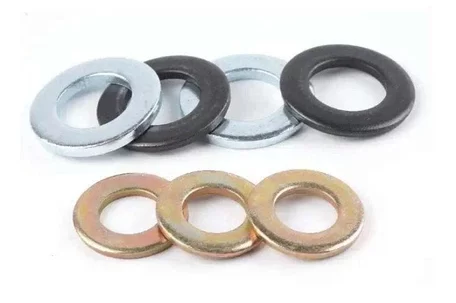
Finishes applied to the base metal of the washers enhance the durability and corrosion resistance of the material.
Surface Treatments We Can Provide:Plain,Zinc Plate,Colour Zinc Plate,HDG,Brass,Black,Dacromet,Teflon.etc.
What Are The Advantages Of Our Bolts?
Zinc / Trivalent Zinc
The most popular commercial platings, zinc is both economical and corrosion resistant, commonly used in environments where excessive moisture will not be present. On top of the zinc, a clear chromate finish is applied to create an additional layer of protection against white oxidation spots that can form in the presence of moisture. The most common way of applying zinc coatings to fasteners is through electroplating.
Black Oxide
Black oxide is a "conversion coating", meaning it is formed by a chemical reaction with the metal to form an integral surface, as opposed to an "applied coating" like zinc which bonds to the metal. A post-coating oil finish is typically applied to inhibit the development of rust.
Galvanized
Hot dip galvanizing can be highly effective as a method to apply a sufficient thickness of zinc for corrosion protection in particularly harsh environments. Steel reacts with molten zinc during the galvanizing process, which forms layers of zinc-iron alloy that are bonded metallurgically with the steel surface. The hard barrier created during this process not only resists mechanical damage, but also has a very low rate of corrosion.
Other coatings
Other coatings like galvanization and phosphating are common for particular types of hardware, like screws meant for fence or window applications.
Application Of Washers
Washers are essential when coupling parts using bolts and nuts. Here is the purpose of washers.
Spacing and Alignment
Washers can be utilized as spacers. When we insert a threaded fastener into an object longer than its depth, the fastener protrudes from the rear of the object. For instance, when one tries to insert a 3-inch-deep fastener in a 2-inch-deep object, the 1-inch fastener sticks out the back of the object.
However, inserting a washer into the fastener before screwing it to the object helps prevent this protrusion. Therefore, it does this by creating padding, ensuring the fastener does not go too deep into the object. Also, washers compensate for slight variations in the spacing found between types of fasteners and parts, ensuring proper alignment.
Load Distribution
Washers assist in spreading the load more equally across a broader surface. The risk of material deformation, damage, or failure is decreased by washers because they disperse the force produced by a nut or bolt. For instance, driving a screw into a softer material could result in cracks appearing on its surface. However, with washers, there is minimal damage tendency.
Seal/Liquid Protection
Washers in this category stop water and other liquids from entering and exiting. Seal washes are frequently applied in water pipelines and connectors to make a waterproof seal. Liquid-sealing washers are constructed of a flexible material, and this material choice ensures they press completely against the object’s surface.
Vibration Absorption
Vibration absorption is a feature of some washer types. Washers in this category are mainly not metals. Instead, softer materials like plastic, rubber, or urethane are used to create them. These softer materials are better at absorbing vibrations than harder elements like metal.
Additionally, vibration-dampening washers help protect coupled parts from damage. This is especially true when one of two objects connected by a threaded fastener vibrates violently.
Damage Prevention
The nut or bolt head and the surface it is fastened to are separated by washers, which serve as a protective barrier. This preserves the material’s integrity and maintains the connected surfaces’ visual appeal by preventing marring, scratches, dents, and other damages.
Corrosion Prevention
Washer fasteners, especially those made from corrosion-resistant materials, offer additional protection against corrosion and rust. This is crucial in locations where prolonged exposure to moisture, strong chemicals, or other elements can deteriorate the fastening system.
About Washers Packaging And Transportation
Packaging Materials
Choose materials with good moisture-proof, shock-proof, anti-corrosion and sealing properties, generally choose cartons, wooden boxes, plastic packaging and other materials.
Packaging Specifications
In compliance with relevant national standards and regulations, packaging specifications should be reasonably designed based on the size, weight, material, quantity, etc. of the product to avoid collisions and extrusions during transportation.
Packaging Form
There are two forms of single product packaging and batch packaging. Single product packaging is generally suitable for small batches of products, and batch packaging is suitable for large quantities of products.
Logo
Mark the product name, quantity, specifications, moisture-proof grade, shelf life and other information on the packaging.
Save
Avoid contact with toxic and flammable substances. The storage environment should be kept dry, ventilated, and clean. The storage location should be set up reasonably to avoid damage and contamination.
Transportation Method
It can be carried out through various modes of transportation such as road, railway, aviation, and sea transportation, among which road and sea transportation are the most common. We are close to Shanghai Port and Ningbo Port, most customers choose Shanghai Port. We pursue smooth transportation, avoid bumps and collisions, and do our best to ensure that products are delivered to customers in good condition and on time.
Temperature and Humidity Adjustment
Try to maintain a suitable temperature and humidity environment to avoid being affected by excessively high or low temperature and humidity, which may affect the quality and life of the product.
Safety Guarantee
Take necessary safety protection measures during transportation to avoid dangerous situations such as fires, explosions, accidents, etc., and ensure that they are not damaged or lost during transportation.
Insurance Requirements
In order to ensure transportation safety and improve transportation insurance coverage, you can purchase cargo transportation insurance when purchasing our high-value fastener products to avoid accidental loss or damage.
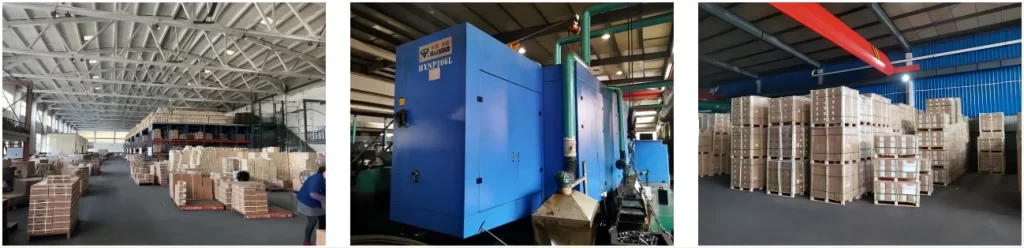
Our Washer Factory

MYWAY Services
MYWAY strictly complies with the requirements of the ISO9001 quality certification system, strictly controls quality, implements it at every level, and assigns responsibilities to everyone to ensure the healthy operation of the comprehensive system of design, production, sales, and after-sales service. In order to strengthen communication with users, better provide users with high-quality products, and better serve users with the brand, we have made the following commitments:
1. Products are designed and manufactured in strict accordance with standards. We produce non-standard products according to the drawings provided by customers.
2. Pre-sales service
Serving customers: product introduction, answers to technical questions, and engineering-assisted design.
3. Sales service
1). The products are based on the needs of user orders, with quality and delivery time as the premise.
2). During the use of the product, our company regularly organizes technical and quality inspection service personnel to visit and solicit feedback from users on the quality, usage status, improvement opinions and other aspects of the product, so as to further improve product quality.
4. After-sales service
1). If users have any problems or information when using our products, please report them back to the company in a timely manner so that the company can properly handle and improve them so that our products can better meet your requirements.
2). If the product does not work properly or is damaged due to quality problems during the warranty period, our company will be responsible for free repair or replacement. If the product is damaged or does not work properly due to improper use by the user, our company can provide repair services. If users need it, our company can provide users with free pre-sales and after-sales technical consultation.
.After-sales service. Users are required to fill in the product service and quality feedback information form and make appraisal opinions in order to improve the quality of MYWAY products and services.
FAQ
Q: Non-metal washers: what are they?
A: Non-metallic materials are more weatherproof, vibration-resistant, and cost-effective than stainless steel or aluminium.
Q: Can metal washers withstand heat?
A: The 310 stainless steel washer is designed for high-temperature applications and provides oxidation resistance up to 2000°F under mild cyclic conditions.
Q: Can metal washers be magnetic?
A: A washer is magnetic, yes!
Q: What are the purposes of metal washers?
A: Metal washers distribute the load of fasteners, such as screws, bolts, nuts, or other forms of securely fitting fasteners.
Q: What are fabric washers used for?
A: Red vulcanised fibre washers are generally used within the plumbing trade where a seal to prevent leakage is required. Vulcanised fibre washers purpose is to absorb the fluid they come in contact with and swell slightly to fill the joint or gap within the pipe of flange.
Q: Are washers made out of steel?
A: Washers can be fabricated from a variety of materials including, but not limited to: Steel – Carbon steel, spring steel, A2 (304) stainless steel, and A4 (316/316L) stainless steel. Non-ferrous metal – Copper, brass, aluminium, titanium, iron, bronze, and zinc. Alloy – Silicon bronze, Inconel, Monel, and Hastelloy.
Q: Which is better fibre or nylon washers?
A: Widely used in many areas of plumbing, fibre washers tend to be somewhat easier to compress than rubber or nylon versions. This can mean that they are at less immediate physical risk of damage from over-tightening, potentially leading to a longer lifespan depending on the tap type and how it’s used.
Q: Why are metal washers used?
A: Load Distribution.The primary purpose of most washers is to evenly distribute the load of the threaded fastener with which they are used. Threaded fasteners stress the material in which they are driven. Driving a screw into wood, for example, may cause the wood to crack around the surface.
Q: What are zinc washers made of?
A: When a bolt is tightened the shank sustains a direct stress, due to the elongation strain, together with a torsional stress, due to the torque acting on the threads.
Q: Does washer thickness matter?
A: If you have decided to use washers when fastening a product, you should first make sure that it’s of the right thickness. This often depends on what you want the washer to do. For instance, if you want to make sure that the assembly is as tight as possible, you could use a washer that is thick.
Q: Why are washers made of brass?
A: Brass shim washers are most commonly in use for applications that use low friction levels. For example, you will often see brass shim material being in use in plumbing, bearings, gears and electrical appliances. This is due to the material’s resistance to sparking.
Q: What is the difference between zinc and stainless steel washers?
A: While zinc alloys are cheaper than stainless steel, they are also susceptible to more rust when exposed to moisture. Stainless steel can rust from excessive, prolonged exposure to water, but because it has much more resistance, this makes it a better alternative for most applications that may face exposure to water.
Q: What is the difference between zinc and galvanized washers?
A: Both zinc plating and galvanizing is an application of zinc plating. The big difference is thickness: zinc plating is normally 0.2 mils thick. Hot dip galvanizing might be 1.0 mil thick – you get over 5 times the protection with galvanizing.
Q: What is aluminum washer?
A: Round flat washers can be utilized to cover large holes. In addition, aluminum flat washers are engineered to prevent damage to flat surfaces from bolts and nuts.
We’re professional bolt manufacturers and suppliers in China, specialized in providing high quality customized products with low price. We warmly welcome you to wholesale or buy discount bolt in stock here from our factory. Contact us for free sample.